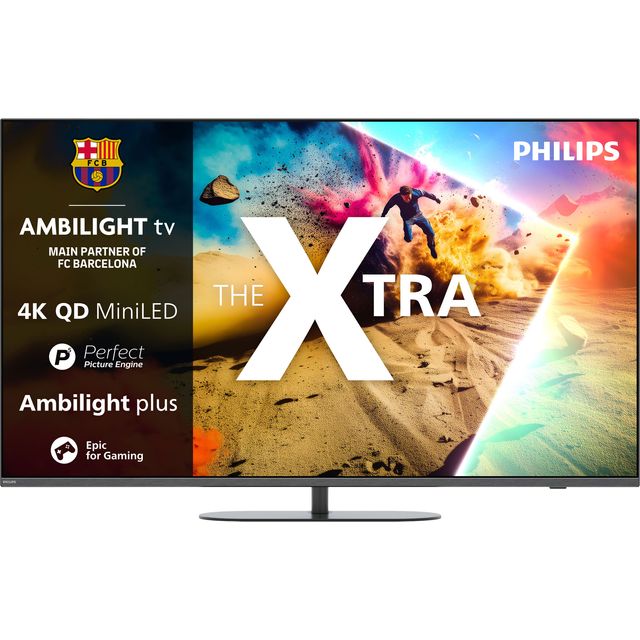
The MLED950 has one feature rivals cannot imitate with a picture preset: Ambilight throws colours from the screen onto the wall, making a 65-inch image feel less like a black rectangle in the room. Philips backs that experience with Mini LED brightness, broad HDR support, four HDMI 2.1 inputs and a 60W 2.1 speaker system. The weaker link is Titan OS, whose app depth and long-term support deserve checking, and the exact television still lacks the sort of independent picture test needed for a firm performance award.
Buy it if…
- Ambilight appeals to you
- You want four advanced gaming inputs
- A stronger built-in speaker system matters
Skip it if…
- A required app is missing from Titan OS
- The television cannot sit near a suitable wall
- You want independently measured local dimming
Not the right fit? See other tv & cinema or browse buying guides by budget →
What's good
- Three-sided Ambilight
- QD Mini LED with broad HDR support
- Four HDMI 2.1 ports and 144Hz gaming
- 60W 2.1 sound system
Worth knowing
- No reputable full independent review located
- Titan OS app support needs checking
- Local-dimming performance is unmeasured
- Ambilight works best near a plain wall
A closer look, category by category
Picture quality
QD Mini LED combines high brightness with quantum-dot colour, while Dolby Vision and HDR10+ cover both major dynamic HDR formats. Ambilight can reduce perceived eye strain in a dark room and increase immersion, but it does not improve panel black level. Dimming zones, blooming and colour accuracy still require independent measurement.
Gaming and motion
The 144Hz panel and four HDMI 2.1 inputs are unusually generous, with VRR, ALLM and FreeSync Premium support. Ambilight can follow games for a more enveloping effect. Competitive players still need measured input delay rather than assuming the panel frequency tells the whole story.
Living with it
Titan OS is simpler than Google TV but has a smaller ecosystem, so confirm every must-have UK service before purchase. The 60W 2.1 audio system should provide more weight than basic television speakers. Ambilight needs some clear wall space to look its best.
Price
The exact 65-inch Philips MLED950 was listed at £1,199 in the UK when checked on 1 August 2026. That 65-inch price is used throughout this review and by the buying guide; a cheaper 55-inch version cannot improve its value score. Prices and promotions can change, so confirm the model number and final basket total before buying.
Price last checked: 1 August 2026Real-world use cases
Atmospheric film room
Ambilight extends colour beyond the panel and changes the room experience.
Gaming with several sources
Four capable ports avoid a connection compromise.
App-dependent household
Titan OS compatibility should be checked before picture features.
Where it sits in the market
TCL's C8K has stronger independent evidence, LG's QNED86 has familiar webOS and Hisense offers Freely. Philips stands apart through Ambilight and above-average integrated audio rather than a proven picture-quality lead.
How we reached this verdict
This research-based article uses Philips' UK documentation and exact 65-inch pricing. A search for reputable product-specific testing found no mature full review, so manufacturer claims are clearly separated from conclusions and finder eligibility remains disabled.


